
Email Marketing Playbook For Course Creators: Grow From $1M to $100M+ in ARR...
A step-by-step proven roadmap for turning 7-figure creator businesses into 9-figure education empires...

Matt Hommel

I hope you enjoy this blog post. If you want my team to just do your marketing for you, click here.
When it comes to building an email marketing strategy to scale from 7 to 9 figures, most people make a critical mistake:
They don’t align their email marketing strategy with the right phase of growth their business is in…
For example, a company doing $100 million in ARR with 2,000 products needs a completely different approach than a company doing $1 million with 2-3 core offers.
I know this firsthand because I stand at the VP level, going over marketing and revenue growth with 9-figure VPs, while also steering the ship for my portfolio companies as a growth partner & investor (like what Alex Hormozi does with his portfolio companies).
In this guide, I’m going to walk you through the differences in email marketing for 7-figure course creators, 8-figure course creators, and 9-figure course creators/education companies…
Depending on where you are, you’ll walk away with a proven roadmap for scaling to the next level, and doing things like the best in the world (possible clients of mine).
I’ll be starting with smaller 7-figure ones, then build to the 9-figure ones. If you’re a creator at multi-6 figures the 7-figure strategy works for you too.
The first thing to lock in here is your promotion & revenue model
This is determined by how many offers you have.
If your company does $100 million in ARR and you have a catalog of over 2,000 products, your promotion strategy is going to be different than a company that does $1 million in ARR and has only 2 or 3 core offers.
Digital marketer, for example, is going to promote courses differently than a company like Live Traders.
PESI Inc and Pilot institute will have a different strategy than someone like Lead Gen Jay’s Insiders program or Teri Ijeoma’s Trade and Travel.
I’m going to walk you through the differences, starting with the lower range…
First, though, let me quickly explain why 7, 8, and 9-figure strategies are so different:
You see, when you’re bigger you can send emails 3 times daily, because you have so many offers and marketing angles to take… Think of 9-figure companies with hundreds of ad creatives running across multiple ad channels (30+ creatives, headline combos), Google ad words, LinkedIn and so on…
Now, you can see why you can take this same approach with emails. For the smaller guys though, you likely have less creative angles to use that work. Hence, you have less email angles too.
Now, I’m going to walk you through the differences, starting with course creators in the 7-figure range…
For 7-figure course creators, you’re looking at 3 to 5 emails per week.
I like 5 if you’re good at writing emails. This averages out to about 20 emails per month.
This factors in everything:
Why this frequency works for 7-figure businesses:
When you’re at this level, you typically have 2-3 core offers. Less offers means less marketing angles to work with. Less marketing angles means you need to be strategic about your email frequency to avoid burning out your list.
Here’s where most 7-figure course creators mess up:
They try copying the email frequency of 9-figure companies without having the offer catalog or marketing angles to support it.
Remember – those bigger companies often have 30+ ad creatives running across multiple ad channels… and they can profitably do that for a reason:
They have more offers and creative angles.
It’s the same thing with your email list.
Email is just a traffic & sales channel.
If you’re a 7-figure course creator, are you running tons of offers to one main business that has the same email list (no, not you guys running SaaS and info offers for horizontal businesses).
That’s why typically, you want to add one more proven offer to your catalog.
To add more offers, usually you take a macro view of your customer acquisition and ascension.
When you hit a sticking point, usually, there’s only 2 ways to grow past that plateau.
Fundamentally, there’s 2 levers here:
Let’s break each one down.
The first one, usually can be launching lower ticket offers to bring more buyers into your eco-system.
For example if you have a $2k course that’s working, but you’re struggling to get more qualified leads in the door…
Usually a smaller offer can help you there.
You want to make sure this smaller offer is congruent with your higher ticket offer.
So, it could be something that people struggle with before buying the $2k course.
A low ticket offer, like a book or mini course, or a $297-$497 mid range offer.
The second one here is thinking more about retention and upselling.
So, at this point you know your main core offers are good. But what’s next?
What else can you do to add more value to customers and grow their lifetime value?
One example can be:
If you have 2 or 3 flagship course offers around $2k each, you can launch a MASTERMIND for $10k to $20k.
Masterminds are a great way for businesses in this range to ascend their buyers.
In fact, I helped a 7-figure client add an extra $50k in MRR by launching a mastermind.
This was also a completely adjacent business model too (separate topic). So we built out low ticket offers to ascend people into the high-level mastermind. And we also used those to gather the interest of qualified buyers.
On top of that, we also upsold current buyers of our $2k courses and membership programs.
Plus, I helped an 8-figure client add an extra $20k in MRR by launching a paid community. This helped us take a large pool of people who bought our front end products, and turn them into repeat buyers, as the front-end offer was only a 1x purchase.
If you’re a course creator in the 7 to 8-figure range, I highly recommend some form of subscription to drive continuity for your business…
Once you’ve reached 7 to 8-figures, you already have enough data to spot what people are willing to buy repeatedly.
Side note: People try to START with subscriptions which is often a big mistake, as you don’t even know what people will pay you monthly, yearly, etc. for just yet.
Having a few validated offers that got you to 7 or 8-figures gives you stronger insights into what people will pay monthly for.
So now we know how to expand our catalog, by either creating new low-ticket offers to bring qualified buyers into our email list that will take our more expensive programs… Or we know how to get people to spend more money with us with either a more premium backend offer or a subscription.
How do you know what to offer?
This is determined by looking at sales and customer data, and identifying what’s the weak point in your revenue model. Is it customer acquisition or retention?
You can also book a call with me and my team if you want help with this, since we’ve already helped several others like you do it.
Disclaimer: This is what you do when you plateau.
Sometimes, you don’t need more offers. You just double down on what’s working, and keep ensuring you have the right talent in-house to help you keep growing.
Now that you understand how to build your offer catalog, let’s talk about how to actually promote these offers through email.
Your promotion strategy is determined by how many offers you have…
If you have 2-3 offers, here’s what I recommend:
For 7-10 offers:
When you hit 20+ offers:
Important:
Only promote offers that actually convert.
If you have 3 good offers and 7 bad ones, focus on the 3 good ones.
Don’t waste time on things the market shows they don’t want.
Let’s dive deeper into what your email calendar looks like with promos included.
First, we must map out your promotion calendar for the year.
If you’re serious about growth, you have to be forecasting revenue and mapping out your yearly plans of growth. Then reverse engineering your marketing plans by quarter, then by month. This makes email strategy way more simple.
100% cohesion across all marketing channels is key here…
From email, to organic social to paid advertising. This prevents people from promoting one thing on the email list, but then somebody posts something on social media that completely contradicts that.
That’s a good segue into broadcast/newsletter email strategy.
Outside of your promo emails, there’s a list of emails you want to send:
The bottom line is you wanna build authority and reciprocity with your list…
These could be tools and tutorials your audience uses. Stock Trading tactics, Cold Email Softwares, how to get leads from Facebook groups (if you’re b2b, coaching or real estate), how to dress better, how to speak better, your content or YouTube creator setup… All things that your audience will find value from and will look forward to reading.
You’re either making a deposit or a withdrawal:
Good email marketers make deposits that generate sales… My favorite is “infotainment” emails that teach people something, and then sneakily sell things, getting people to watch VSLs or buy affiliate softwares without feeling like they’re being pitched anything.
Here’s an example of that:
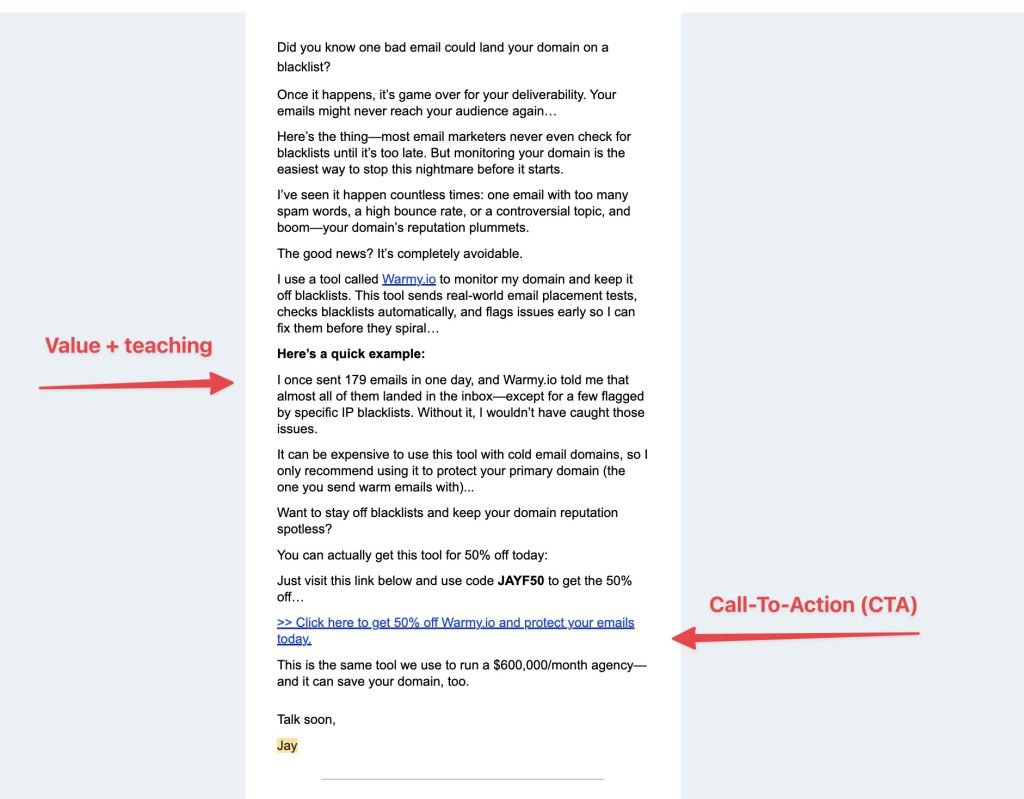
As you can see, this email teaches people something, then transitions into a software offer.
Here’s another example from the stock trading niche:
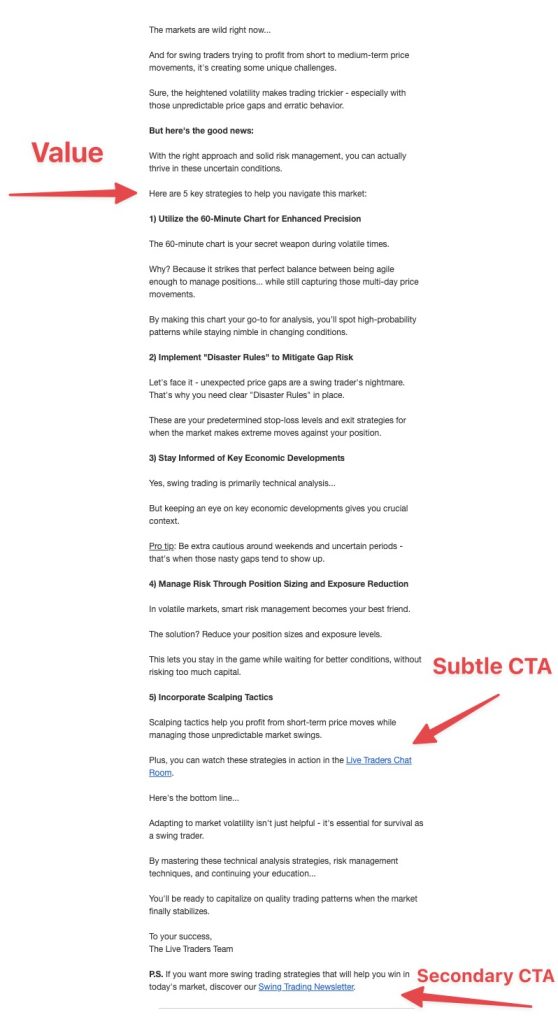
These kinds of emails CRUSH…
They let you continually make sales, without ever making your audience feel like they’re being pitched.
When you’re bigger you can send 3 times daily, because you have so many offers and marketing angles to take… Think of 9-figure companies with hundreds of ad creatives running across multiple ad channels (30+ creatives, headline combos), Google ad words, LinkedIn and so on…
Now, you can see why you can take this same approach with emails. For the smaller guys though, you likely have less creative angles to use that work. Hence, you have less email angles too.
In my Free Email Marketing Course, I talk about forecasting revenue…
(Right around the 1:23:00 mark.)
Typically, to scale your 9-figure business, or multi-8 figure business to 9 figures…
You’re spending a lot more time:
Then, you’re spending time on wondering when you can prompt the winners without too much frequency.
In my experience, you can run the same promotions 4-5 months apart without too much product fatigue.
This, of course, depends on how many times you’ve already launched the offer, and how much your list has grown. The reason being, you have to account for how many new email subscribers have not seen the offer yet, and their likelihood of buying.
For example:
If you expect a 2% CVR on the offer…
And your list has grown 15,000 subscribers over the last 5 months (since you last promoted this offer)…
The AOV is $297…
2% x 15,000 NEW subscribers would be:
300 new buyers who have not seen the offer before.
300 x $297 = $89,100.
Now, you think about if that will help you reach your revenue goals.
Historically, I like to think about a 10-20% decrease in conversion rates between re-launching offers to 9-figure email lists.
Here’s the secret, though…
If your list GROWS 10-20% between each promo cycle…
That 10-20% decrease cancels out.
So as long as you keep growing your email list, it’s possible to keep running evergreen promotions to your email list for a reliable chunk of cash.
We call this “predictable” promos…
Things that you can rely on to keep making money throughout the year and consistently scale your company.
And if you want help doing this to scale your business past 9-figures, don’t forget to book your call today while you can.
The bottom line is when you’re growing at this scale, running payroll with lots of EEs, and have investors to make happy… There’s no time for pussyfooting around here.
You have to be consistently growing, and the way you do that is by promoting products that sell with the right frequency. Then, of course, looking at what works, and then launching new ones.
At this point, you likely know how to launch a high-converting offer. So we won’t get into that too much. Read $100M offers by Alex Hormozi for more help on this.
Study what worked in the past.
One last example: If you’re launching a new Options Trading course. Look at what made your last options course work well, then replicate that. It’s a new offer, obviously it should be better than the old one, and not some copy/paste nonsense.
Follow Jeff Walker’s product launch formula to keep launching new and exciting products that your email subscribers can’t wait to buy!
At multi-8 figures, you’re pulling product sales reports constantly to identify winning angles/offers, then re-launching them every 4-5 months without product fatigue. This creates “predictable promos” – reliable revenue you can forecast. At this stage, it’s less about email content and more about data analysis and promotion cadence strategy.
3-5 emails per week, which averages about 20 emails per month. This includes your regular broadcasts, special promos (holiday sales, webinars, etc.) and value content.
Only if you don’t have enough offers and marketing angles to support it. Lots of 9-figure education companies send 3x daily, and they have hundreds of ad creatives running across multiple channels – those same principle applies to email. Think about it: if you have 30+ proven ad variations for different offers, you have 30+ email angles too.
Three things: offer catalog size, promotion frequency, and data sophistication. At 7-figures with 2-3 offers, you run quarterly 14-day promos and send 3-5 emails/week.
At 9-figures with hundreds of offers, you run daily promotions, send 2-3 emails/day, and spend most of your time pulling product sales reports to identify winners. You’re analyzing what worked, when to re-launch without fatigue, and forecasting revenue. The transition happens gradually as your catalog grows – you don’t jump from 5 emails/week to 20 overnight.
When it comes to email marketing for course creators, one size doesn’t fit all. Your strategy has to align with your business’s growth phase.
Whether you’re doing $1M with 2-3 core offers, or scaling past $100M with 2,000+ products, you now have a proven roadmap for each stage of growth.
Remember: The best in the world got there by matching their email strategy to their business size. They didn’t try to copy 9-figure strategies when they were at 7-figures, and they didn’t stay stuck with 7-figure strategies when they were ready to scale bigger.
If you want help implementing these strategies in your business, book a call with me and my team. We’ve helped multiple course creators scale from 7 to 9-figures using these exact frameworks.


“Matt is an email wizard. Our list is growing faster than ever and our
conversion rates have more than doubled.”

“Our email revenue has grown a lot since working with Matt, and more importantly he's helped us lower our CPA on cold traffic by 4x.”

“Matt drove conversions across multiple campaigns. His copywriting resulted in higher open rates, click-through rates, new customer acquisition and ascension, and increased revenue for the company.”


